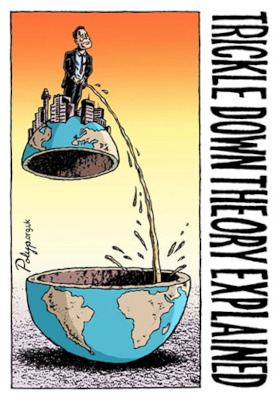
[Click image to view article]


[Click image to view article]
good news
bad news
Poll

Gross inequality of wealth and opportunity and the creation of a permanant underclass indicates that our society is losing its moral compass

Vote now to see current results

See previous poll results

Latest material

Private Equity investors should keep away from science, technology or creative enterprises - The Great Terra Firma/EMI disaster


The investment banks will have to be reformed by externally imposed force. International action is needed.


"Those who the Gods wish to destroy, they first make mad".
Nationalism in a global world - Britain and the European Union.


Prince Charles describes the threats to the planet - and slams market fundamentalism. See his full speech


The chickens are coming home to roost


AFTER THE MELT-DOWN.
What has been done to create a financial system to better serve Society? Nothing much.
Why??


Pay for Performance, The Great Confidence Trick


How to improve corporate performance


Investment styles and Investors' Values must radically change


Why did most experts miss the impending economic disaster?


Tax havens are an immoral blight - the Vatican speaks out


Barefaced hypocricy? Brown and Cameron slam the financial markets


Does capitalism really have to be founded on greed?


New technologies and government


Bad news - Tony Blair cashes in

HAVING THEIR CAKE - WHAT IT'S ABOUT

Understanding the global financial system, the philosophy that drives it and it's effects on society

A PERSPECTIVE - 2002 TO 2010

Pat Scott and I wrote the book, "Having Their Cake" during 2002. In the book, we reviewed the increasingly speculative and aggressive behaviour of the investment markets and their impacts on larger corporations. Most of the predictions that we made back then have come to pass. This is not very surprising, as anybody with half a brain and a reasonable capacity to "connect the dots" should have been able to see that the behaviours of investment banks and many top managers would not create strong, sustainable enterprises. But for a variety of reasons, most economists, pundits, politicians and a large part of the media remained fixed in the view that the loose financial controls predicated by market fundamentalism would create unending wealth. The book led to this website and widening concerns about the global financial system. The results of letting investment banks have their way are now quite clear - but as economist Joseph Stiglitz - (one of a small but honourable band which was not carried away by free market dogmas) - is now asserting, the banking bandwagon is rolling again and politicians are by and large too timorous to take on the massive financial and political strength of the global banking leviathans.

So at the beginning of 2010 a battle is raging between the massive financial and political power of many investment banks and a rather ragged collection of regulators, some politicians, a few economists - and large numbers of "ordinary" people who are angry, but uncertain about how to mobilise themselves.

Some are arguing strongly that the current banking system needs significant reform if it is to become less toxic and serve societal interests.

In the view of the writer, most of the evidence and logic points towards reform - but the battle to achieve it is likely to be long and the outcomes still very uncertain. As Chinese philosophers were purported to say, we live in interesting times!

A lot of the material in this website was written before the collapse of the global banking system and subsequent bail-out by governments. Earlier material reflects the author's mounting concerns about the growing instability and venality of the investment system and the ineffectual nature of regulation.

Of course, everything did not work out exactly as predicted in the site, but the vector of the concerns represented in it was quite clear before many economists and central bankers even dimly realised that all was not well.

Now, in the post crash era, the same general issues that were emerging before the melt-down still face us:

Market fundamentalism has failed - finding an intellectually rigorous replacement is crucial to our well-being. This site reviews the options

The growth of a global financial system, operating outside the restraints of democratic accountability, is one of the most important new developments of our generation. As the recent disasters are revealing, it affects us all in our day-to-day lives.

As individuals, we all have a stake in the economy through our work, savings, consumption patterns and pensions.
The wealth and wellbeing of nations is affected by the ability of international, regional and national economies and institutions to cope with global economic forces.
We all have a big interest in the health of the planet, which is being vitally influenced by the effects of economic and political ideas.
Many of us are concerned about the plight of people in poor countries, but often unaware of the extent and causes of poverty and social exclusion in our own societies.

Understand the dynamics of the global financial system and the fatal flaws in the economic philosophy that has driven it.
Making sense of complexity and competing ideas.

Few people are well-versed in the dynamics of the financial markets. We are bombarded by a mass of often competing ideas about what is good for us and also by a cacophony of advertising and exhortations to consume and to borrow.
Behind this 'noise' is a huge complex of interactions between investment banks, corporations, regulatory institutions, Think Tanks, academic researchers, governments and international bodies like the International Monetary Fund. The nature of these interactions is often invisible to the average citizen but nevertheless deeply affects their vital interests.

The choices between economic and social philosophies

The 20th and early 21st centuries have witnessed titanic struggles between ideologies - Soviet centralism and free-market capitalism - and more recently free-market fundamentalism and social market philosophies.
The outcomes of these contemporary ideological struggles will vitally affect everything in the world, from the wealth and well-being of individuals and nations to the future of the planet.
This website aims to get to the roots of the important economic and social ideas that influence the actions of governments, industries and individuals

Author

This site is the result of several years of research by Don Young, a retired company director, who first became concerned about the impacts of the investment markets on companies he worked for, and latterly has widened his interests to examine the wider financial and economic systems. The level of debate in the site should be useful to all educated people with a normal level of interest in the state of the nation and the world, economic realities and business practice.
So read this site if you want to understand the dynamics of the economic system, the fascinating battle of ideas affecting its evolution, and how these things affect our lives. And don't worry - our serious purpose is moderated by a sense of humour.

Site guide

Ideas that drive our financial system

Every economic system is rooted in ideas that are often implicit. This section will equip readers with an understanding of the ideas that drive the world of economics

Our financial/industrial system

A look inside the financial and industrial system that drives economies

Consequences

How the economic system affects our worlds and the future of the planet

Resources

A wide range of cases, reading, research and opinion

Archive

Where it all started, "Having their Cake", the book

Author

Don Young, his life and hard times

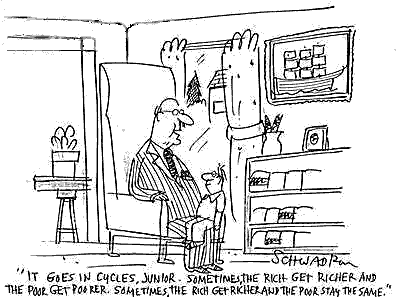
Cartoon: It goes in cycles, Junior - sometimes the rich get richer and the poor get poorer, sometimes the rich get richer and the poor stay the same

TRANSATLANTIC PERSPECTIVES - A VIEW FROM AMERICA

The Institute for Shallow Thinking

We met Anne Carr and Joe Weiss in New Zealand and were immediately engaged by their acute observations of the world we live in, intellectual rigour and sense of humour. Both are well-educated professional people; Joe had retired from a senior management position in a major manufacturing and technology company. Too often in the recent past, external impressions of the United States have been coloured by the views of vociferous neo-conservatives.
The Institute for Shallow Thinking, founded by Anne and Joe, provides a welcome counterpart, that of educated, thinking Americans with a deep interest in the wider world, which has at times been drowned out by the conservative 'noise'. To our mind they represent America as a force for good in the world.
Here are the first of their occasional contributions to this website:

Go to top